Our approach
The science behind closing skill gaps.
We combine AI, learning science and behavioral psychology to create a system that actually works.
See my career gapsIt starts with your resume
Your CV tells a story.
Our AI reads between the lines: your experience, the technologies you've used, the roles you've held, and where you want to go. We don't just look at what you know; we understand the context of your career and where the gaps are.
- Deep CV parsing with semantic understanding
- Skill-to-job-title correlation analysis
- Market demand scoring for each gap
- Personalized priority ranking
How it works
Our four-pillar framework.
A complete system, designed around how professionals actually learn and grow.
Pillar 01
AI gap analysis
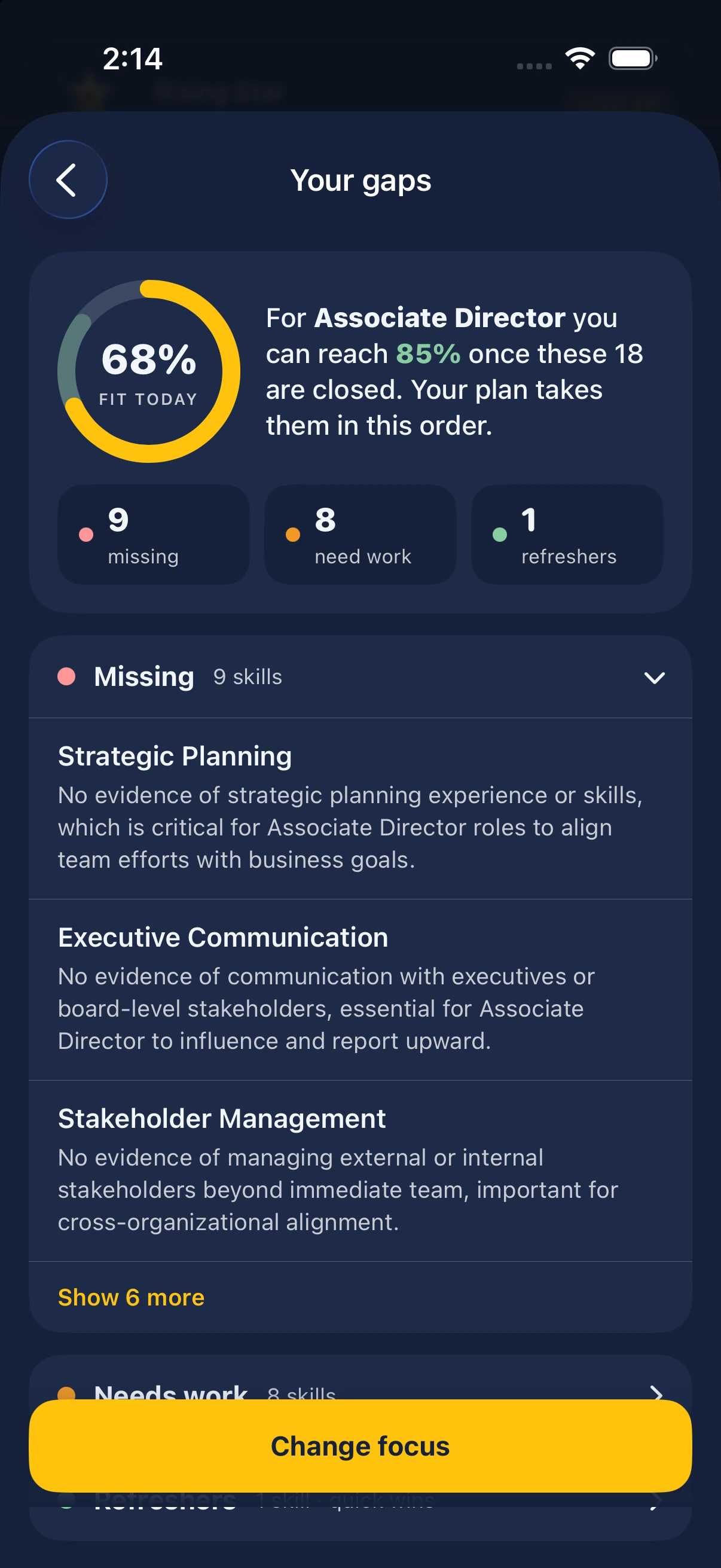
Upload your resume and the role you want. Our AI engine analyzes your current skills, background, and target role to identify critical gaps: not just technical but also soft skills, industry knowledge, and market relevance.
- Intelligent CV parsing and context understanding
- Target role competency mapping
- Market trend analysis and skill relevance scoring
- Hyper-personalized gap identification
Pillar 02
A 12-week structured learning plan
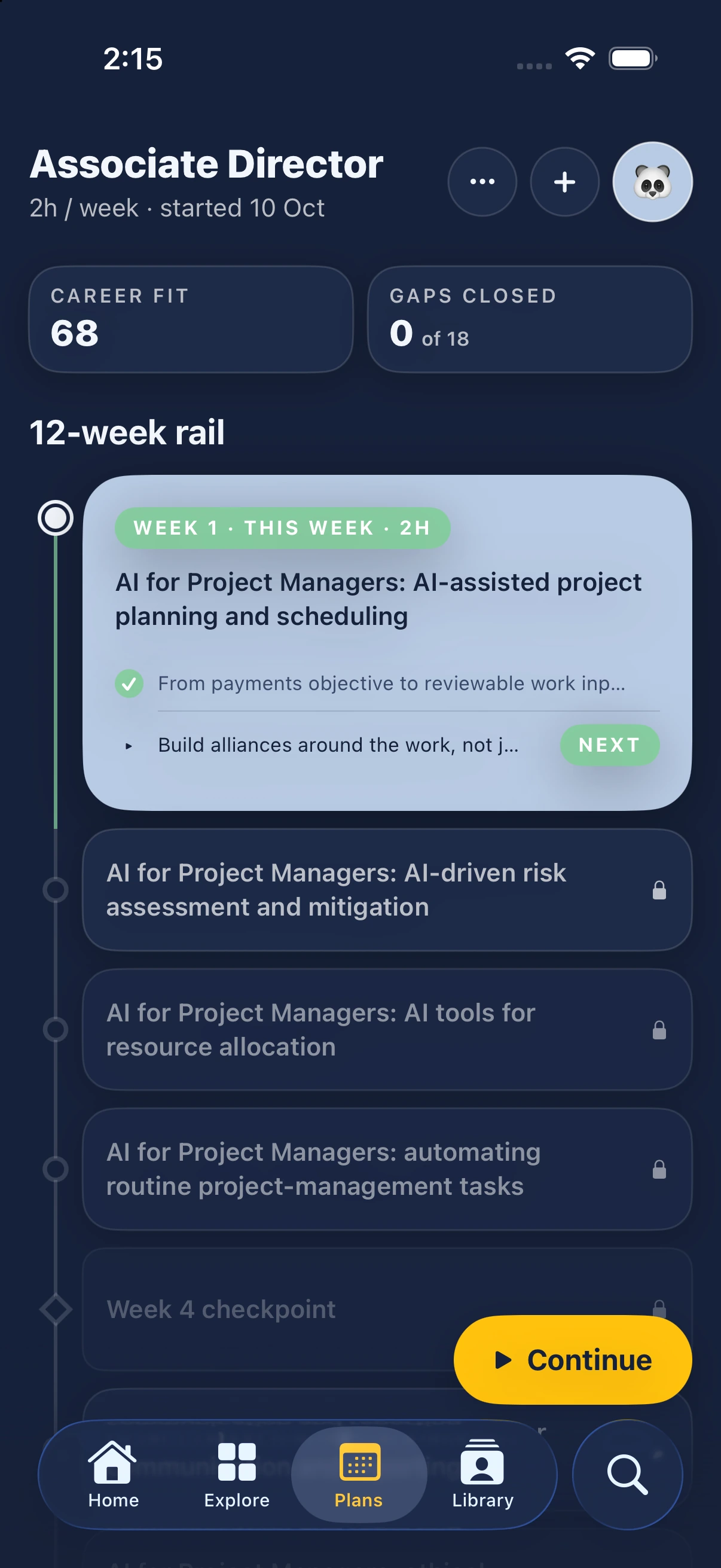
We don't just identify gaps: we engineer a 12-week learning roadmap sized to your weekly hours. Each week has a theme, 7 daily focuses, curated resources with time estimates, and progress you can track.
- Week-by-week thematic structure, 7 daily focuses per week
- Curated resources with realistic time estimates
- Balanced skill coverage (technical and soft)
- Adapts as you learn: a reassessment re-tunes your pending weeks
- Real-world "do this today" actions, not busywork
Pillar 03
Microlearning, done properly
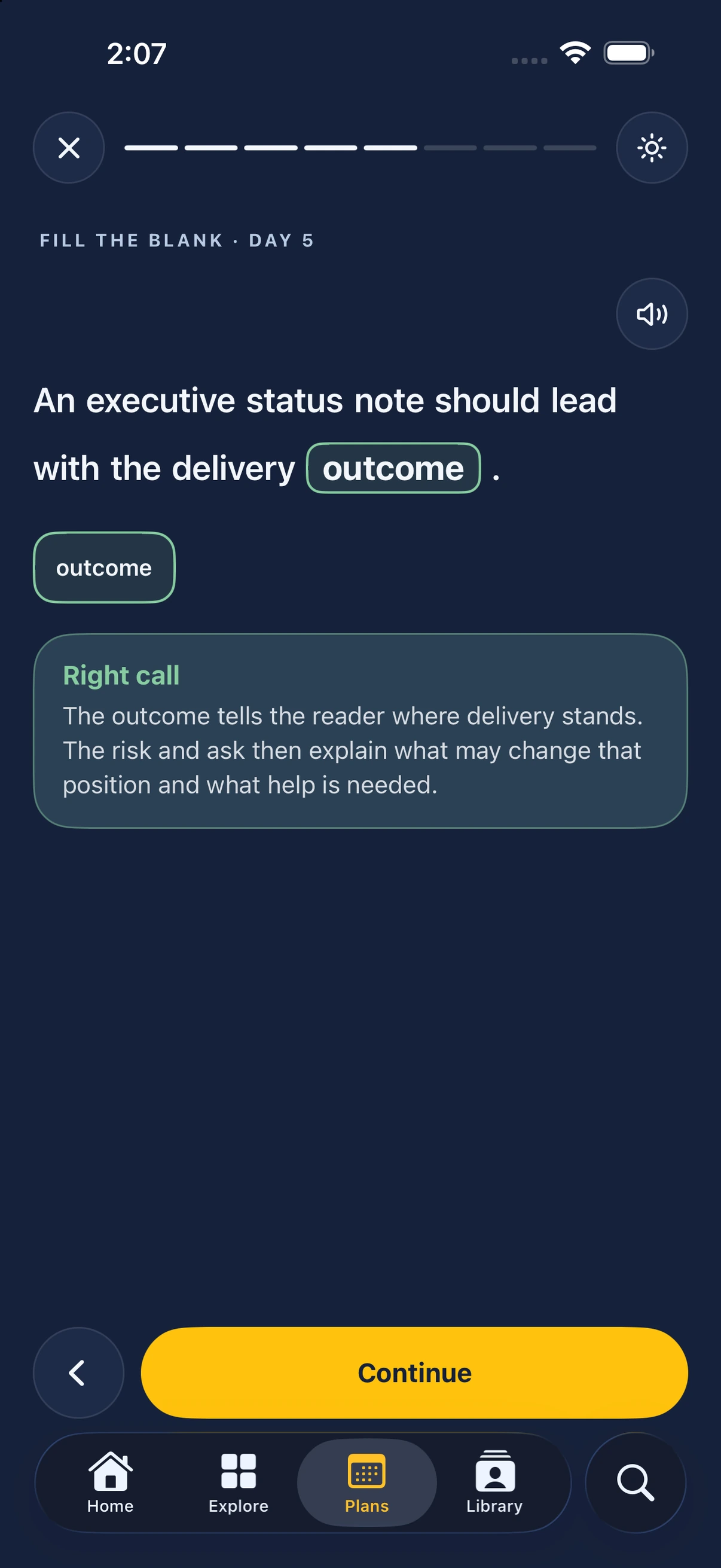
We believe in learning science. Research on spacing and retrieval suggests learning sticks better when it's bite-sized, spread over time, and immediately applied. Daily lessons take about 15 focused minutes, built from interactive blocks: tap the missing word, scenario decisions, roleplay dialogues, rewriting weak lines with feedback on your own words. The 2-minute Daily Practice reviews what you've learned on expanding intervals tuned to how well you remember.
- Daily Practice spaced repetition on expanding intervals: 1 day, then 3, then a week, then longer
- About 15 focused minutes a day, in 2 interactive core items
- Every item ends with an applied scenario check, never rote recall
- Boosters: extra interactive micro-sessions (5–10 min); half of each is you doing, not reading
Pillar 04
Motivation and consistency, gamified
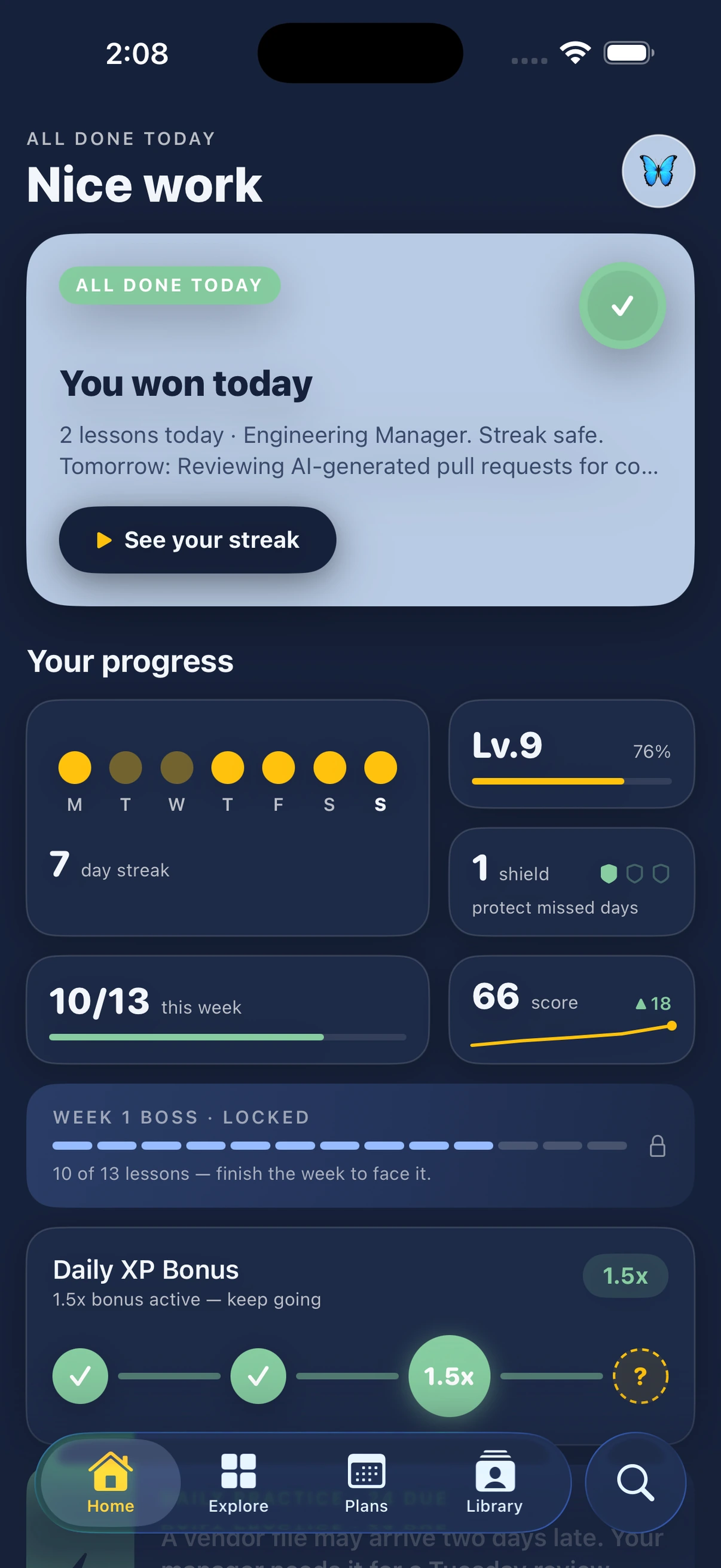
We use behavioral psychology principles to build lasting habits. Daily XP, streak shields, Streak Wagers, achievements, a Weekly Boss and a GapFix Score (0–100) turn learning from a chore into something you look forward to.
- Daily XP rewards for engagement
- Streaks with shields that protect momentum, plus opt-in Streak Wagers
- A wall of achievements to unlock as you go
- A live GapFix Score (0–100) that tracks your readiness
The science, in short
Backed by learning science.
Every feature is grounded in evidence-based learning principles and behavioral psychology.
Explore the learning science1·3·7·14·30
Spaced repetition
Memory research going back to Ebbinghaus suggests that revisiting material at growing intervals beats cramming for long-term retention. The Daily Practice reviews each skill on expanding intervals (1 day, then 3, then a week, then longer), tuned to how well you remember.
Test > reread
Retrieval practice
Studies of the testing effect (Roediger & Karpicke) suggest that answering questions strengthens memory far more than re-reading. That's why every lesson item ends with an applied check, and the Daily Practice is question-first.
~66 days
Habit formation
Research by Lally and colleagues found new habits took roughly 66 days on average to form. Our 12-week plan, 84 daily focuses, is designed for sustainable behavior change, not a sprint.
3 drivers
Intrinsic motivation
Gamification taps into autonomy, mastery and purpose: the three drivers of intrinsic motivation that last beyond extrinsic rewards.
Microlearning
Why 15 focused minutes beat 40-hour courses.
- Fits your life
- A ~15-minute lesson day fits into your morning routine, lunch break or commute, and Boosters are extra 5–10 minute interactive micro-sessions for when you want more. No need to carve out 2-hour chunks for a course you'll never finish.
- Higher completion
- Short daily sessions get finished far more often than 40-hour courses. You're more likely to finish what you start, building momentum.
- Better retention
- Research on spaced repetition suggests bite-sized learning spread over time consolidates far better than cramming. The Daily Practice revisits every skill on expanding intervals, for example 1, 3, 7, 14 and 30 days, tuned to how well you remember.
- Immediately applicable
- Every lesson ends with an applied scenario check, and "do this today" actions turn what you learned into a real-world step within hours.
Gamification
The psychology of gamification.
We use behavioral psychology to turn learning into a sustainable habit. Here's how.
XP rewards
Earn experience points for every lesson, quiz and streak. Immediate feedback rewards the behaviour you want to repeat.
Progressive levels
Unlock new levels as you progress. The increasing challenge keeps you engaged and provides clear milestones.
Streaks build habits
Daily streaks create consistency loops, and streak shields protect momentum when life happens instead of punishing you for it.
Wagers & achievements
Opt-in Streak Wagers let you stake XP on a 7-day streak, and a wall of achievements marks every milestone along the way.
The result
Sustainable growth.
Traditional learning platforms treat all learners the same. They assume everyone has 10 hours a week and wants to binge-watch courses. That doesn't work for busy professionals.
GapFix's approach is fundamentally different. We tailor to your context, your pace and your career goals. We use science-backed methods (spaced repetition, microlearning, gamification) that build lasting habits, not temporary motivation spikes.
The result? Learning that actually gets finished, sticks, and, most importantly, translates to career growth. When you finish your 12-week plan, you're not just another certificate collector: you're genuinely equipped with new skills and the confidence to use them.